
Tulsa Through the Tarot · I of XXI
The Magician: The Philtower
Updated
The Magician is the card of raw potential made into something real, and the Philtower is what Waite Phillips made when the oil money had to become a thing you could point at.
What The Magician means
The Magician stands at a table with one hand raised toward the sky and the other pointed at the ground. On the table in front of him lie the four suits of the deck: a cup, a coin, a sword, a wand. Everything he needs is already there. The card is not about luck or a gift from elsewhere. It is about will, skill, and the moment a person takes what they have and makes something out of it.
If The Fool is the step off the edge, The Magician is what happens when the falling stops and the work begins. In a reading it sits beside a project that has moved from idea to action, or beside a person who has the tools and has not yet picked them up. It asks a plain question: you have what you need, so what are you going to build?
The deck this series draws from carries a Waite of its own. Arthur Edward Waite commissioned the cards in 1909 and directed their design; Pamela Colman Smith drew them. No relation to the man in this story. Two Waites: one organized a deck, the other organized a skyline.
The Philtower
Waite Phillips was born on an Iowa farm in 1883 with an identical twin, Wiate. At sixteen the two of them left home and spent three years drifting across the West and into Canada: railroads, mines, lumber camps, fur trapping, no plan beyond the next job. In July 1902 Wiate died of appendicitis in Spokane, and Waite went home. He took six months of college, worked as a bookkeeper, and in 1906 followed his older brothers Frank and L. E. into the oil fields around Bartlesville, Oklahoma. The brothers would found Phillips Petroleum. Waite sold them his interests in 1914 and went out on his own, moved his headquarters to Tulsa in 1918, and in 1925 sold the Waite Phillips Company to the New York bankers Blair and Company for $25 million.
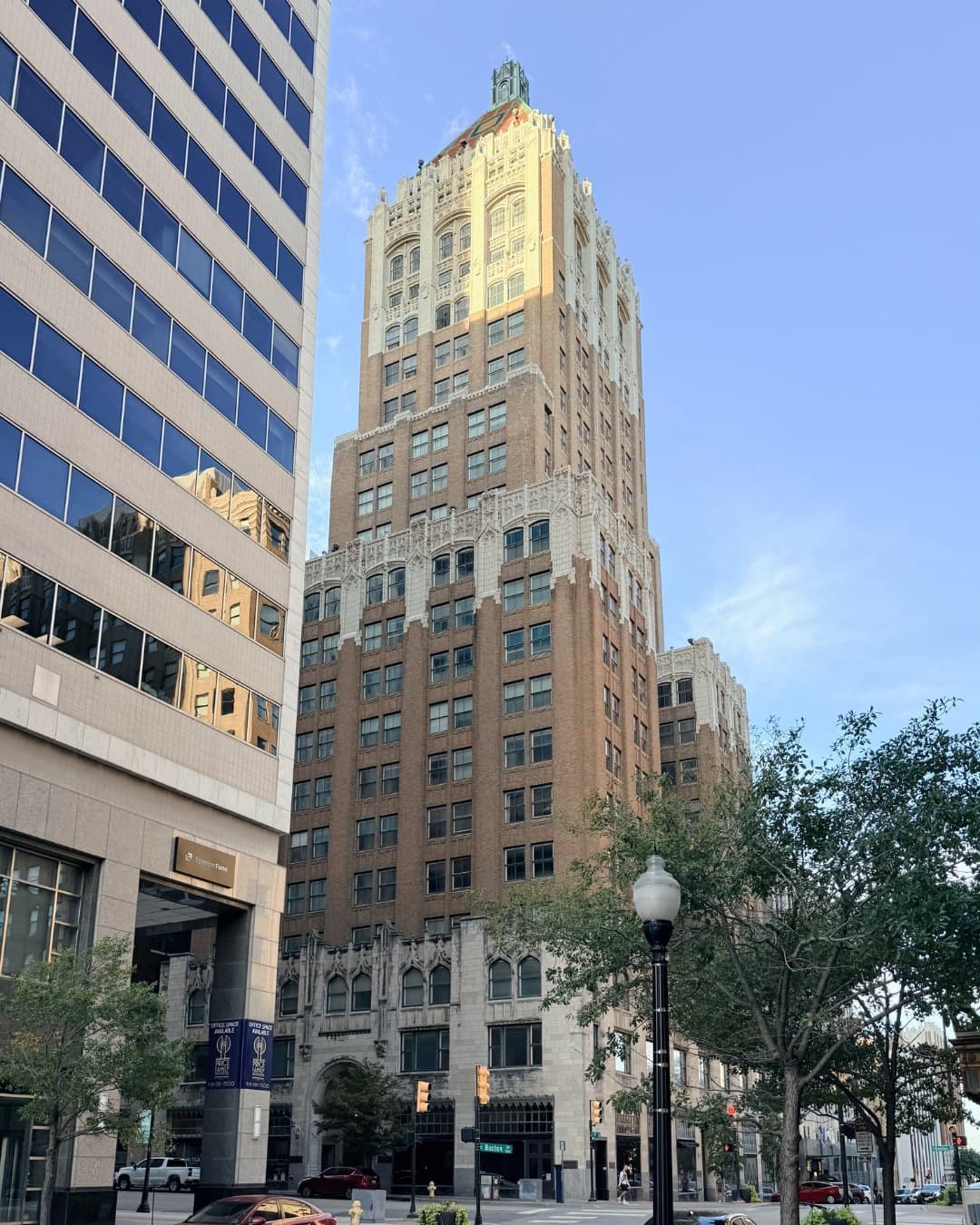
The Philtower is what he did with it. Finished in 1928 at 427 South Boston Avenue, it rises 323 feet and 24 floors, designed by Edward Buehler Delk with Keene and Simpson supervising, in a mix of neo-Gothic and art deco that was briefly the tallest thing in Tulsa. The sloping tiled roof is lit at night. The vaulted lobby ceiling is made of large carved stone rosettes that were cut in Italy and reassembled here by the same craftsmen who made them. Phillips kept his own office on the twenty-first floor, and it is still preserved.
The building was the first of three he put on Boston Avenue and its edges. His house, Villa Philbrook, was finished in 1927 and given to the city in 1938 as an art museum. The Philcade went up across Fifth Street between 1929 and 1931, joined to the Philtower by an 80-foot tunnel. In 1941 Phillips deeded the Philtower to the Boy Scouts of America as an endowment for Philmont, the 127,000 acres of New Mexico ranch he had given them in 1938 and 1941. The Scouts sold the building to local investors in 1977; floors twelve through twenty became lofts in 2004. It has been on the National Register of Historic Places since 1979 and sits inside the Oil Capital Historic District.
Why this pairing
Phillips is the Magician because his life runs the first two cards of the deck in order. Three years on the road with a twin and no destination is The Fool. Coming home alone, learning the books, and turning an oil lease into a company is The Magician: the same restlessness, now with a table and four tools on it. He did not find the oil. He organized it, and organizing is the Magician's whole art.
The building is the card's gesture set in stone. One hand raised, one hand lowered: as above, so below. The Philtower has a lit roof you can see from across downtown and a tunnel under Fifth Street you cannot see at all. What was underground in Oklahoma came up as a tower, and the tower keeps a passage back underground. This series will come back to that tunnel. For now it is enough that on a clear night in 1928 the oil that had been potential for a hundred million years stood 323 feet over Boston Avenue with its roof lit, made manifest, marking the skyline of the city that made him.
Visiting
427 South Boston Avenue, between Fourth and Fifth Streets. The lobby and its rosette ceiling are visible from the Boston Avenue entrance when the building is open. The roof is best seen from Fifth Street looking east at dusk, when the tiles are lit.
Book a reading in Tulsa
Private sittings run fifteen, thirty, or sixty minutes, in person in Tulsa.