Tulsa Through the Tarot · II of XXI
The High Priestess: Boston Avenue Methodist Church
Updated
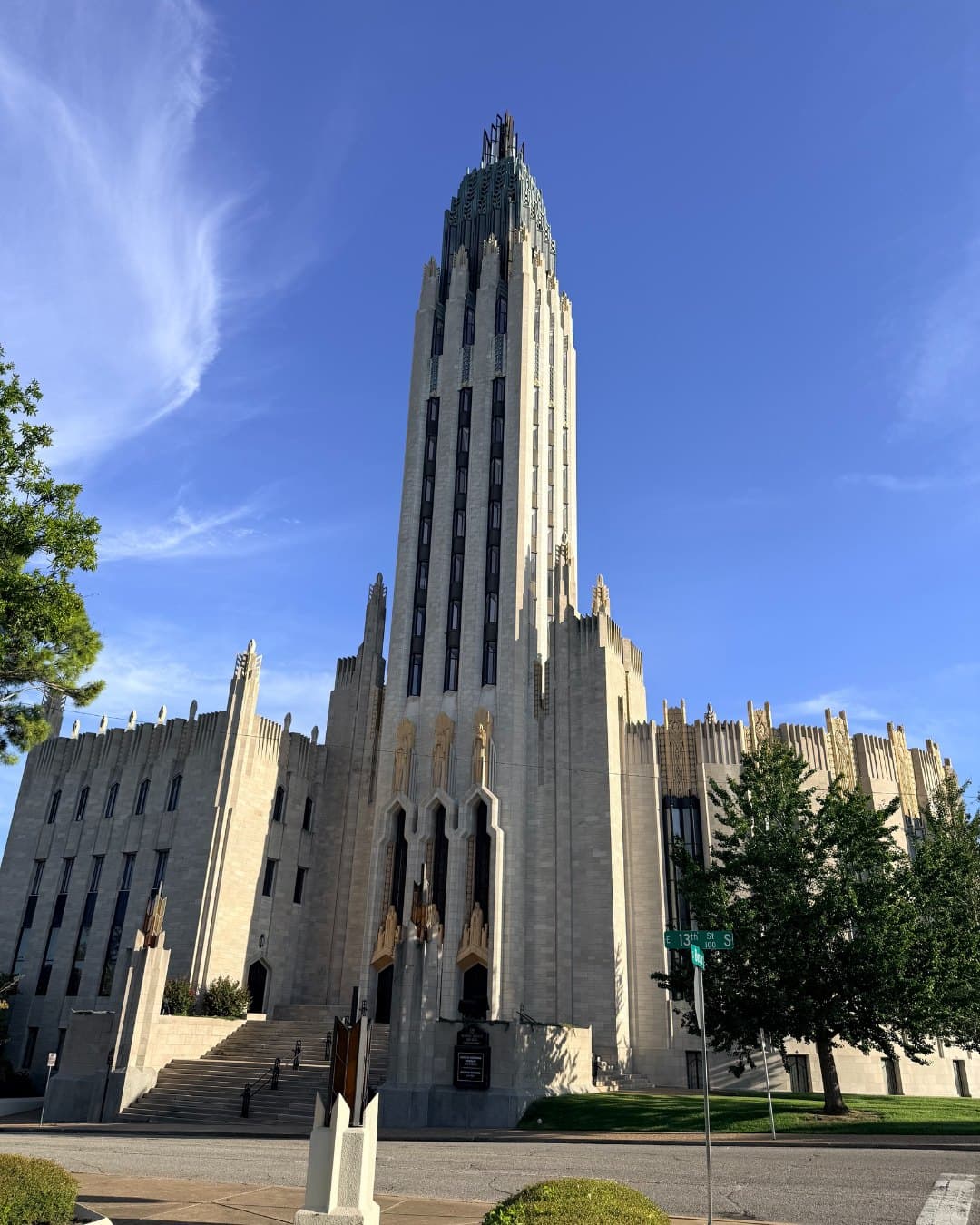
The High Priestess is the card of what is held rather than explained, and Boston Avenue Methodist is the tower at the south end of the avenue whose glass takes the first light of every morning.
What The High Priestess means
The High Priestess sits between two pillars, one dark and one light, with a veil hung behind her and a crescent moon at her feet. In her lap is a scroll, partly covered by her robe, so that you can see there is something written and cannot read what it says. She is the second card of the deck and the first one that does not act. She and the Magician are the blueprint and the builder. He is the manifested: he takes potential and brings it into the world with the four tools on his table. She is the unmanifested: pure potential, intuition, the knowledge that has not been revealed yet. His power is superficial without her depth. Her wisdom stays hidden without his ability to act. Neither is the source of the other; they are two halves of one thing.
She stands for the inner life: intuition, memory, what a person knows before they can say it. In a reading she tends to appear when the answer is not out in the world yet, when the right move is to wait, listen, and sit with a question rather than force it. She is not a rule-giver. That is the Hierophant, three cards on, with his keys and his two kneeling clerks. The Priestess has no keys. She has a threshold, and she lets you decide whether to cross it.
A question she fits: what do I already know about this that I have not let myself say?
Boston Avenue Methodist Church
Boston Avenue Methodist Church stands at Thirteenth Street and Boston Avenue, where it closes the view south down the street the Philtower and the BOK Tower share. The congregation outgrew its corner at Fifth and Boston, the lot the Philcade now stands on, and built here between 1924 and 1929 at a cost of $1.25 million. The design is credited to two people: Adah Robinson, an art teacher at Central High School who later chaired the art department at the University of Tulsa, and Bruce Goff, a young architect at Rush, Endacott and Rush who had been her student. Who deserves the larger share has been argued for ninety years. Goff's side wanted his name on a cornerstone; the church sided with Robinson, and no cornerstone was ever laid.
What they built is one of the few Art Deco churches in the country, and probably the finest. The tower rises 225 feet in Indiana limestone and Minnesota granite, faced with terra cotta, and ends in a stylized sculpture the church describes as two hands raised in prayer, abstracted so far into stepped terra cotta that most people take it for a spire. The motif repeats at the building's other high points and beside its doors. The ornament is botanical rather than biblical: the tritoma, or torch lily, chosen for a stem that stands for strength and a bloom that stands for generosity, and the coreopsis, which grows in the driest soil and stands for hardiness. Over the south doors ride three circuit riders in terra cotta, Bishop Francis Asbury, Bishop William McKendree, and a figure modeled on a Tulsa preacher who had ridden the circuit for fifty years. Inside, the sanctuary is round rather than long, under a dome forty feet above the floor that the church says stands for the infinite, and light is worked into the building as its central symbol.
It was placed on the National Register of Historic Places in 1978 and named a National Historic Landmark in 1999. It is also, today, a stated home for people who have been told elsewhere that they are not welcome: the congregation's own words are that it welcomes everyone into membership, leadership, and participation, and it started an Initiative for Justice and Reconciliation in 2021. You do not have to be Methodist to sit in it. The doors are open on weekdays and the sanctuary can be toured.
Why this pairing
Boston Avenue is a street of oil money made visible: the Philtower, the Philcade, the bank tower, later the glass of the BOK Tower at the north end. At the south end, closing the same street, stands the one building on it that is not about the money. The same boom paid for it, $1.25 million from a congregation of the people who were getting rich, and what they built with it was a tower that ends in two hands raised in prayer, abstracted into stone. The Magician's half of the street is the built one: oil turned into limestone and lit roofs, will and action you can point at from six blocks away. The Priestess's half is the blueprint underneath, the depth without which all of that is surface. What this building stands for cannot be seen in the chiseled rooflines, even its own; it is the part of the city that has to be felt rather than looked at. Boston Avenue has both halves, and it is the church at the south end that reminds you the gold was never the whole of it.
The card's veil is the thing. From the street the church is all surface, the most decorated building in Tulsa, and the surface tells you almost nothing about what is inside: a round room, a dome, a congregation that says out loud who is welcome. The Priestess holds a scroll you can see but not read. The building holds a room you can see the outside of from six blocks away and have to walk up to and enter.
Then there is the light. The glass at the top of the tower faces east, and if you stand a block north at sunrise the first light in downtown lands there before it reaches anything else on the street. I have watched it do that. It is a threshold in the plainest sense, the place where the night ends and the day has not started, and the building was made to hold exactly that kind of in-between. The Priestess sits at a threshold too, and she does not ask what you believe before she lets you stand there. Neither does this congregation. For a city of wanderers and seekers, a good many of them arriving with questions they have not said out loud yet, that is the right building to put at the end of the road.
Visiting
1301 South Boston Avenue, at Thirteenth Street. Walk south from the Philtower and the tower closes the view the whole way. Come at sunrise and stand a block north to watch the east-facing glass at the top take the first light; the praying hands read best in the late afternoon. The church offers tours of the sanctuary; check its site for times.
Sources
- Boston Avenue United Methodist Church: Our building
- Boston Avenue United Methodist Church: Justice and reconciliation
- Encyclopedia of Oklahoma History and Culture: Boston Avenue Methodist Episcopal Church
- National Trust for Historic Preservation: Who really designed Boston Avenue United Methodist Church?
- Wikipedia: Boston Avenue Methodist Church
Book a reading in Tulsa
Private sittings run fifteen, thirty, or sixty minutes, in person in Tulsa.