
Tulsa Through the Tarot · III of XXI
The Empress: Woodward Park
Updated
The Empress is the card of growing with what is already there, and Woodward Park is where Tulsa, a city made rich by drilling, planted its abundance instead.
What The Empress means
The Empress sits on a cushioned throne in a field of ripening wheat, a stream falling behind her, twelve stars in her crown and the sign of Venus on her heart-shaped shield. She is the mother of the deck, and her card is about growth: fertility, pregnancy, the fact of motherhood, and everything else people bring into being. She is a renaissance too, creativity and free thought and the freedom to say it. She is not a beginning or an ending but a state of affairs: things blossoming, and someone happy to let them.
She rules beside the Emperor, the next card, as his other half, not his rival. He is authority and straight lines, geometry drawn over a world of chaos. She is the organic half, the one who works with the randomness. She asks you to tend, feed, and let a thing grow at its own pace. Reversed, she can mean a season for pruning rather than growing.
A question she fits: what in my life is already growing, and what does it need from me?
Woodward Park
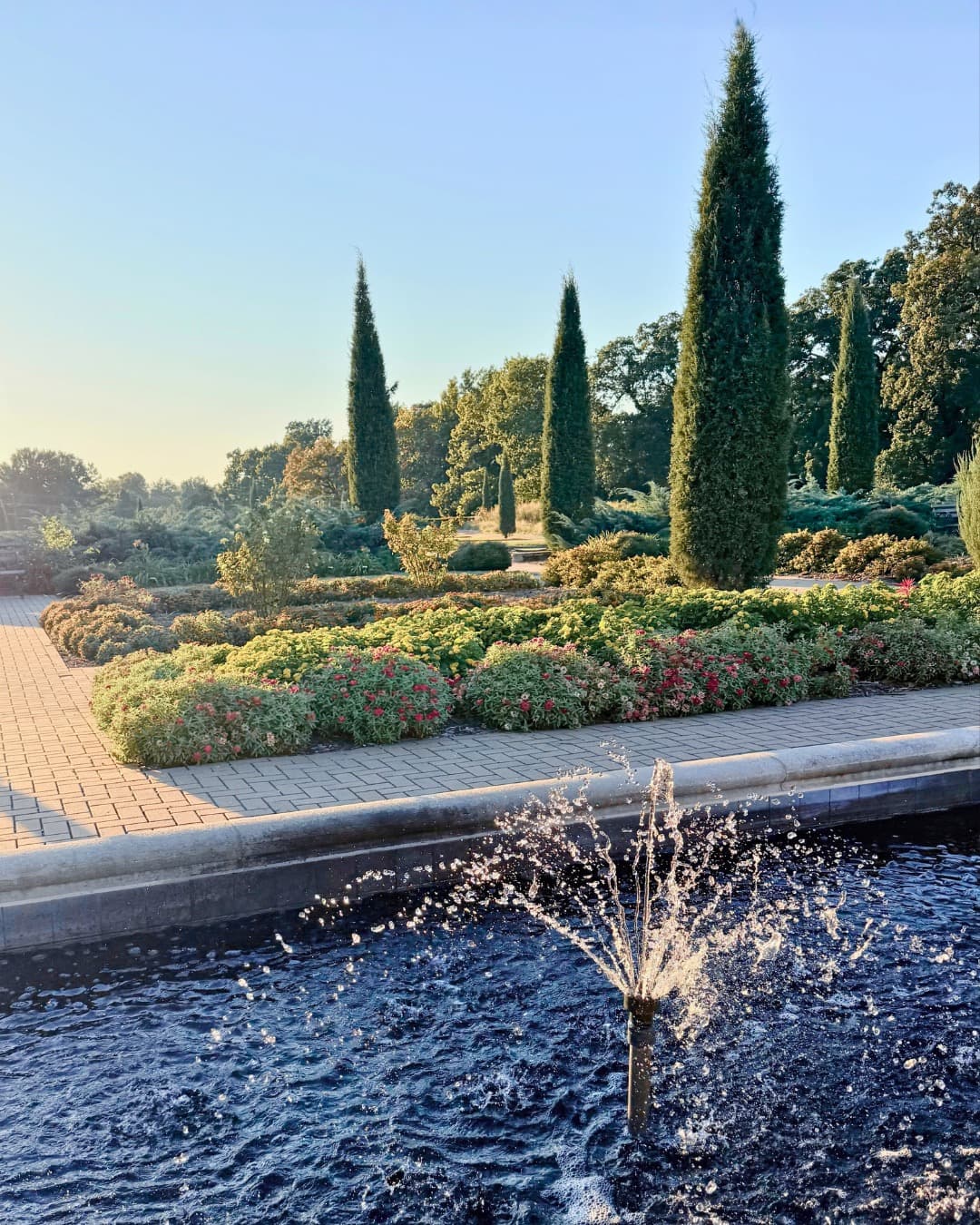
Woodward Park covers about forty-five acres on Peoria Avenue between 21st and 24th Streets. The city bought its first 33.64 acres on December 22, 1909, for $3,532.20, when the site was pasture reached by wagon trails and many Tulsans called the purchase folly. The land was the Creek allotment of Helen Woodward, a Muscogee girl, sold by her father while she was a child. In 1925 she sued, saying she had never consented. The courts sided with the city, the case ended in 1930, and only then did building start.
The rock gardens opened in 1932. In 1934 federal Civil Works Administration relief crews built the Rose Garden to C. Burton Fox's design: five stone terraces, 900 feet long, rising fifty feet above Peoria, mostly by hand and with teams of horses. The Tulsa Garden Club, whose one membership requirement was a garden at home of any size, planted the first roses in March 1935 and kept going until all five terraces held roses in 1961. More than fifteen thousand azaleas went onto an eroded hillside in the late 1960s.
South of the terraces stands an Italian Renaissance villa built in 1919 for David R. Travis, an oil drilling supplier, to a design by Noble B. Fleming. Travis sold it in 1923 after crude prices collapsed, and three more oilmen owned it before the city bought it in 1954 for the Tulsa Garden Center. His brother Samuel's matching house next door is now the Museum of Tulsa History.
Why this pairing
Tulsa got rich on what it took out of the ground. The oil was drilled and controlled; the money built Boston Avenue and the mansions around this park. The house on its south lawn passed from oilman to oilman for thirty-five years, and more than one lost it when the money went. Even this ground was taken, from a Muscogee girl's allotment, but the city planted it. Relief crews built the terraces, home gardeners spent twenty-six years filling them with roses, and the gate has stood open since.
That is the Empress's abundance: not something you control, the way the oilmen tried to control the oil, but something you grow with, a co-creator with what is already there. She is the mother of the deck, and the one thing I knew about this park before I read its history is that there are pictures of me here as a toddler.
Visiting
2435 South Peoria Avenue, between 21st and 24th Streets. The park is free and open every day from 5 a.m. to 11 p.m. The azaleas bloom in April and the roses are at their best from late May into June. The Garden Center mansion is open Tuesday through Friday, and the Museum of Tulsa History is next door at 2445 South Peoria.
Sources
- National Park Service: National Register nomination, Woodward Park and Gardens Historic District (2014)
- Tulsa Garden Center: History of the land
- Tulsa Garden Center: The Mansion
- Tulsa Garden Center: Woodward Park overview
- Tulsa Garden Center: Park rules and hours
- The Cultural Landscape Foundation: Woodward Park
- Wikipedia: Woodward Park (Tulsa)
- Public Radio Tulsa: Tulsa history museum rebrands (2025)
Book a reading in Tulsa
Private sittings run fifteen, thirty, or sixty minutes, in person in Tulsa.