
Tulsa Through the Tarot · IV of XXI
The Emperor: BOK Tower
Updated
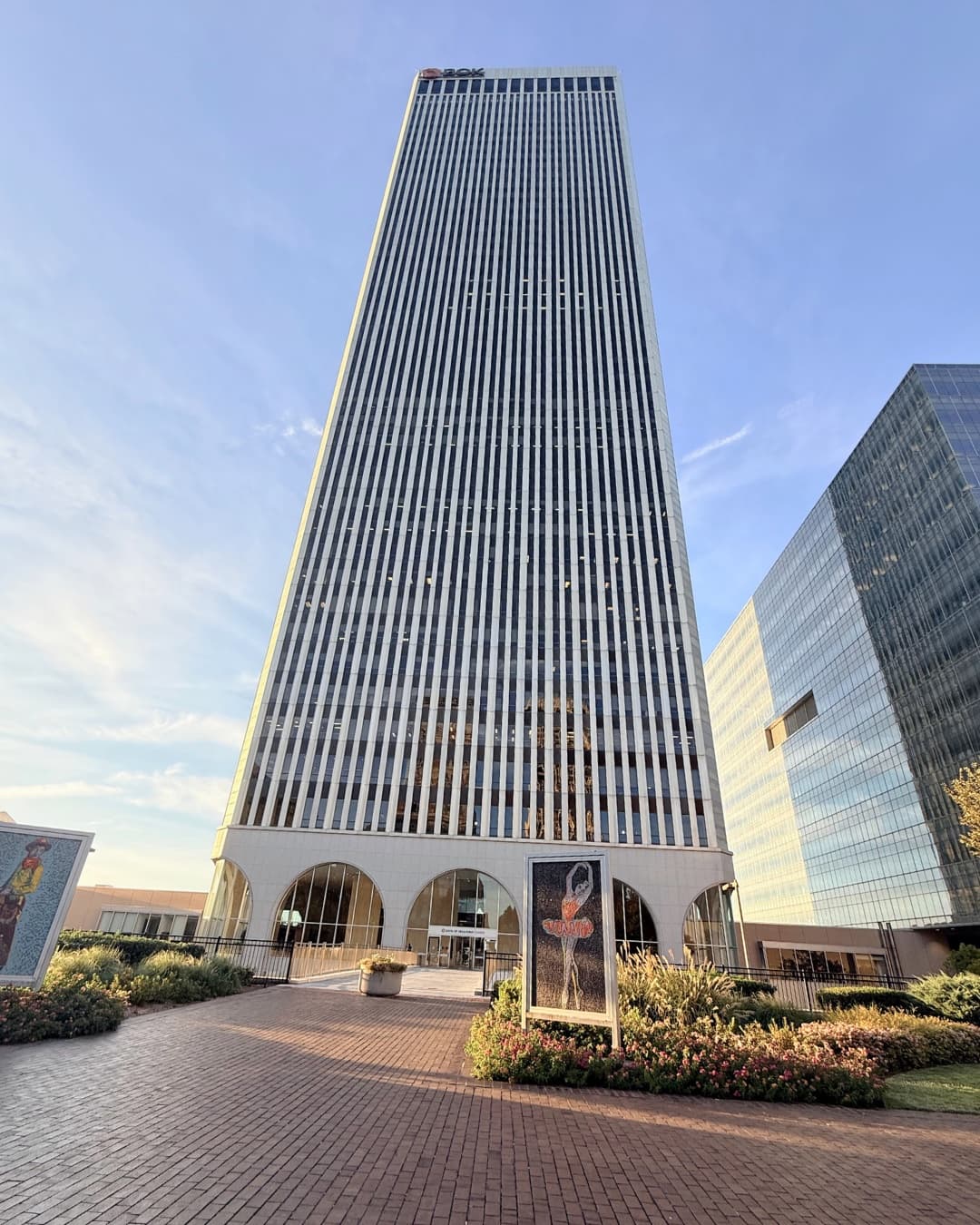
The Emperor is the card of authority and straight lines, and the BOK Tower, Yamasaki's 52-story pipeline headquarters, is Tulsa's: the state's tallest building for thirty-five years.
What The Emperor means
The Emperor sits on a stone throne carved with rams' heads, a red robe over a suit of armor, a scepter topped with an ankh in his right hand and an orb in his left. Behind him the mountains are bare. He is the father of the deck, and he is authority: structure, rules, the one in charge. Upright, that authority is healthy. It holds things steady and gets down to business. Reversed, the same authority turns abusive: rigid where it should bend, control for its own sake. Either way he is serious, and he is not playing around.
He rules beside the Empress, the card before him, as her other half. She is the organic half, the growth that works with the randomness. He is the geometry, straight lines drawn over a world of chaos. Neither is the source of the other. His lines hold as long as they stay a guideline. They fail when they become a box.
A question he fits: what structure does this need, and is the one I have a guideline or a box?
BOK Tower
The BOK Tower stands at the north end of Boston Avenue, facing Boston Avenue Methodist at the south end. It was built as One Williams Center, the headquarters of the Williams Companies, a pipeline builder in Tulsa since 1918. In the 1970s Williams chose to stay and rebuild downtown. Nine blocks were cleared, streets were closed, and part of Boston Avenue was shut for good. Among the buildings that came down, in 1973, was the Bliss Hotel, a ten-story Art Deco hotel of 1929 by Leland Shumway, a demolition preservationists criticized.
Williams hired Minoru Yamasaki because its executives admired his World Trade Center. Construction began in 1975 and the tower opened in 1976: 52 stories and 667 feet, close to half the height of the Twin Towers, with 31 steel columns up each face and narrow windows between them. Around it rose the Tulsa Performing Arts Center, also Yamasaki's, in 1977, a hotel, a plaza and the Forum, a mall with an ice rink. Renamed for its main tenant, the Bank of Oklahoma, it was the tallest building in the state until Devon Tower in Oklahoma City rose past it in 2011.
The detail most people do not know: Yamasaki's model showed two shorter towers side by side. John Williams, the chief executive, lifted one off, set it on the other, and said that was the way it should be.
Why this pairing
I have never liked this building. It does not have the character of the rest of the Tulsa skyline; it is just there, taking up space. It is the Emperor's straight lines, the guideline turned into a box. It belongs to a company whose pipelines run more than 33,000 miles across 24 states, and it stands where nine blocks of old downtown were cleared for it. And yet when Devon Tower took the title of tallest building in Oklahoma, that annoyed me, and I wanted to defend it. You do not have to like authority to want it standing when it is yours.
The Emperor is the father card of the deck, and he comes up a lot with me. I am a father of three, and I grew up without one. I have a love/hate relationship with this card the same way I have one with this tower.
Visiting
101 East Second Street, at the north end of Boston Avenue. The offices are private; the brick plaza at its foot is where the photograph above was taken. The Tulsa Performing Arts Center is across Second Street. The tower reads best from a distance: from the west bank of the Arkansas River, standing beside the deco skyline.
Sources
- Wikipedia: BOK Tower
- News On 6: The history of Tulsa's BOK Tower (2026)
- Williams: 100 Years in Tulsa, TulsaPeople insert (2018)
- The Believer: The Lost Twin, the lone, shrunken World Trade Center tower in Oklahoma
- HistoryLink: Yamasaki, Minoru (1912-1986)
- Wikipedia: Tulsa Performing Arts Center
- Wikipedia: List of Art Deco buildings in Tulsa, Oklahoma
- Wikipedia: Devon Energy Center
- Williams: 2024 annual report
Book a reading in Tulsa
Private sittings run fifteen, thirty, or sixty minutes, in person in Tulsa.